Content Marketing Strategy – The Ultimate Guide to Digital ...

TL;DR
- Shift from content production to strategic Content Orchestration.
- Optimize for Answer Engines to survive the Zero-Click reality.
- Prioritize humanity and first-party data to bridge the trust deficit.
- Focus on 'The Big 5' revenue topics to drive conversions.
- Pivot from driving traffic to owning the definitive answer.
Content Marketing Strategy 2026: The Ultimate Guide to Digital Orchestration
Remember the "Panic of 2025"? Yeah. We all do.
That was the year the internet finally drowned in sludge. AI pumped out so much generic, robotic noise that organic traffic didn't just dip—it cratered. The old playbook ("publish three 1,000-word blogs a week and pray to Google") didn't just stop working. It became a liability.
If you’re reading this, congratulations. You survived the flood.
But now you’re staring down a new reality. The era of Content Production is dead and buried. We have entered the era of Content Orchestration.
This isn't another list of "trends to watch." I'm not here to waste your time. This is a survival guide for the Zero-Click world. It is the blueprint for building "Agentic Workflows" that scale humanity, dominating the revenue topics that actually matter, and accepting a hard truth: your goal is no longer to drive traffic.
Your goal is to own the answer.
Why Has the Playbook Changed? (The Trust Deficit)
Let’s be brutally honest: nobody wants to click your blue link anymore.
The rise of Answer Engine Optimization (AEO) means users are getting their solutions directly from the source—ChatGPT Search, Perplexity, or Google’s AI Overviews. They ask a question, the AI synthesizes an answer (hopefully citing you), and they bounce.
Zero clicks. Zero attribution.
This has created a massive Trust Deficit. Because AI can generate infinite, plausible-sounding content, "Humanity" has become the only premium asset left. Generic "how-to" guides are worthless because a bot can write them in seconds.
The only things that rank now? Verifiable first-party data, contrarian opinions, and deep subject matter expertise.
The industry sees the writing on the wall. According to Gartner's marketing predictions, traditional search traffic is in terminal decline. This is forcing CMOs to shift priorities from volume metrics to "Answer Ownership."
If you aren't the source the AI cites, you don't exist.
What are "The Big 5" Revenue Topics?
Stop writing fluff. Seriously. Stop writing about "Why X Matters."
Your buyers are already educated. They are self-vetting. They smell marketing spin from a mile away.
To win in 2026, you have to pivot to "The Big 5." This is a framework popularized by Impact Plus that focuses on the ugly truths buyers are actually searching for.
These are the topics your sales team hates talking about, but your buyers are desperate to read.
1. Cost and Price
"Contact us for a quote" is a death sentence. Buyers want to know the price now. If you don't list it, they assume you're too expensive or hiding something. You don't need to give an exact dollar figure, but you must explain what drives the cost up or down. Radical transparency here builds immediate trust.
2. Problems (The Negatives)
This is the scary one. You need to write about where your product fails. Who is it not for? What are the drawbacks? When you admit your weaknesses, buyers actually believe you when you tout your strengths. It disqualifies bad leads and closes good ones faster.
3. Comparisons (Us vs. Them)
If you don't compare yourself to your competitors, your prospects will—and they’ll find a biased third-party review site to do it. Own the narrative. Write the "Us vs. Competitor X" article. Be honest. If they are better for small businesses and you are better for enterprise, say so.
4. Reviews
Curate what others say. Don't just cherry-pick the 5-star glory. Address the 3-star complaints. Show how you fixed them. This is reputation management turned into content strategy.
5. Best in Class
Your buyers are searching for "Best CRM for 2026." If you don't have a listicle that ranks the top options (including your competitors), you aren't even in the conversation. Be the guide, not just the hero.
How Do We Build an "Agentic" Workflow?
The biggest mistake marketers made in 2024 was using AI as a writer. "Write me a blog post about X" results in garbage. Every time.
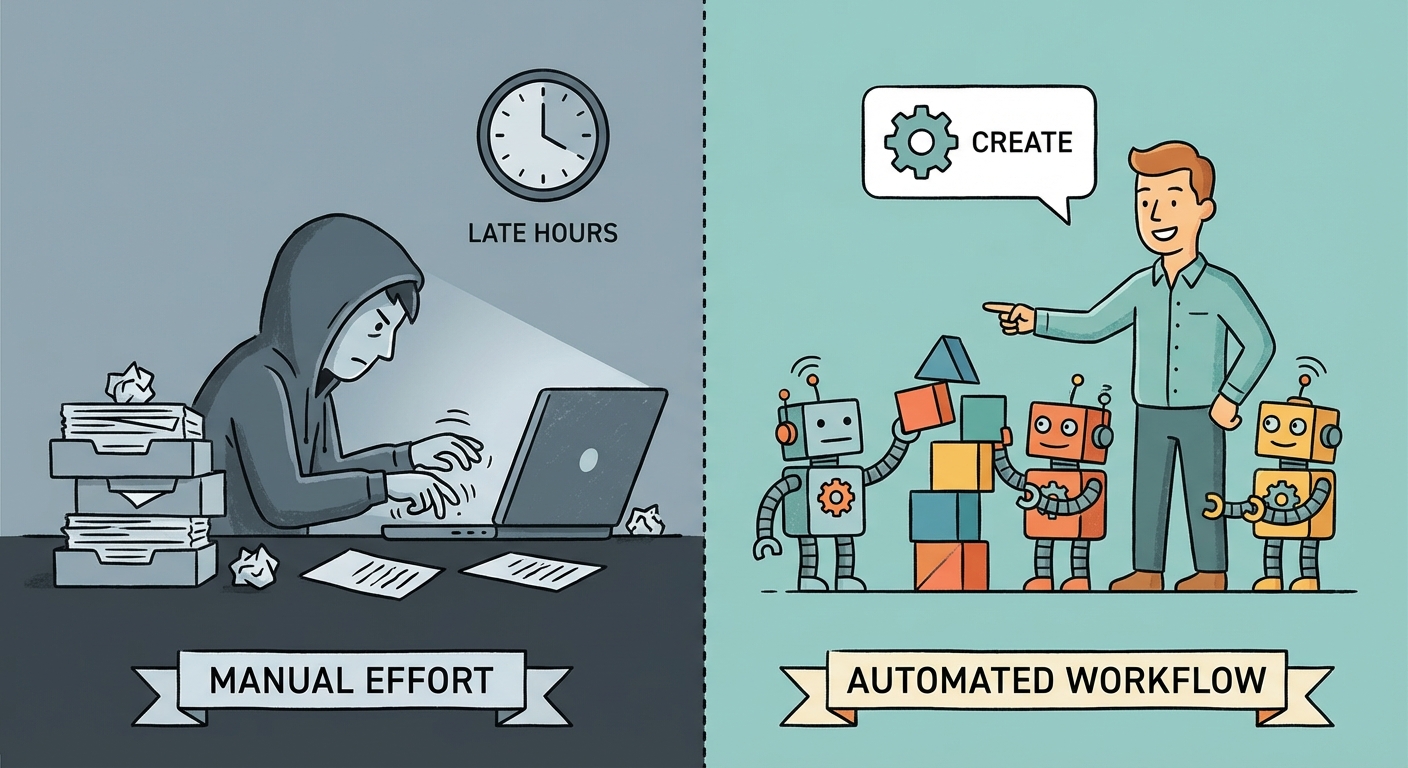
In 2026, we don't use AI as a writer; we deploy AI Agents.
An "Agentic Workflow" treats AI as a staff member with a specific role. You are the Orchestrator. You define the strategy, the Point of View (POV), and the voice. The AI agents handle the heavy lifting of research, drafting, and formatting.
The Content Marketing Institute's trends highlight this shift: top organizations are moving away from "creating content" to "managing content supply chains."
Here is what that workflow looks like in practice:
Notice where the human sits? At the start (Strategy) and the middle (Voice). This is the "Human Sandwich." The AI does the scraping and the reformatting. This allows one strategist to do the work of a ten-person content farm, but with higher quality.
Should We Gate Content in 2026? (The Ungated Revolution)
For years, the rule was simple: "Want this ebook? Give me your email."
That rule is dead.
We are in the age of the Touchless Buying Experience. Buyers want to binge-watch your content like a Netflix series without a sales rep breathing down their neck. If you gate your educational content ("The Secrets to X"), they will just bounce to a competitor who gives it away for free.
The New Rule: Ungate the education. Gate the utility.
Give away the "How-to" guides, the strategy docs, and the white papers. Gate the tools that provide specific, personalized value—like ROI calculators, benchmark data sets, or personalized audits.
We have seen this shift improve lead quality drastically. When you ungate your library, lead volume might drop, but the people who do contact you are educated, qualified, and ready to buy. You can see how this impacted our clients in our Case Studies and Success Stories.
The 2026 Tech Stack: What Tools Do You Actually Need?
You don't need a bloated stack of 50 SaaS subscriptions. You need an "Anti-Bloat" stack focused on speed and video.
- CMS (Headless Preferred): Your content needs to live everywhere—your site, your app, your watch, your smart fridge. A headless CMS separates the content from the design, allowing you to push updates instantly across all channels.
- AI Orchestration Layer: Stop using raw ChatGPT. Use custom GPTs or Agent tools that have your brand voice, style guide, and negative keywords hard-coded into them.
- CRM as Source of Truth: Revenue attribution is the only metric that matters. Your CRM must track which content pieces a lead consumed before closing.
- Video-First Indexing: This is non-negotiable. Search engines now index video content as effectively as text. Record the video first. Use AI to transcribe it into a blog. Use AI to clip it for social. If you aren't doing video, you are invisible.
How Do We Measure ROI in a Zero-Click World?
This is the question that keeps CMOs up at night. If Google answers the user's question on the SERP and they never click your link, did you fail?
No. You just need new metrics.
- Metric 1: Brand Search Volume. Are more people searching for your company by name? If your Zero-Click content is working, you are building brand affinity. They might not click that link, but they will come back later looking for you.
- Metric 2: Pipeline Influenced. Stop looking at "Last Click Attribution." Look at "Pipeline Influenced." Did the buyer consume your content at any point in their 6-month journey?
- Metric 3: Dark Social. This is the "I heard about you on a podcast" or "My peer sent me this link in Slack" traffic. It's hard to track, but essential.
As noted in the Semrush State of Content Marketing, the biggest differentiator between successful and unsuccessful marketers is simply documenting the strategy. You cannot improve what you do not document.
If you are struggling to set up this tracking infrastructure, don't guess. We can help you audit your setup—book a Discovery Call to see if you are ready for the Zero-Click era.
Frequently Asked Questions (FAQ)
How has AI changed content marketing strategy for 2026? AI has shifted the focus from creation to orchestration. It's no longer about writing words; it's about directing AI agents to research, draft, and repurpose content while humans focus on strategy, voice, and emotional connection.
What are the "Big 5" content topics that drive revenue? They are Cost/Price, Problems/Negatives, Comparisons, Reviews, and Best-in-Class lists. These topics address the specific questions buyers have immediately before making a purchase decision.
How do I measure content ROI if traffic is dropping? Shift your focus from "traffic volume" to "pipeline influenced" and "brand search volume." In a zero-click world, success is measured by how many people seek out your brand specifically after seeing your answers in AI overviews.
Conclusion & The "Boardroom Slide"
Content marketing is no longer a volume game. It is a trust game played by orchestrators.
The panic is over. The tools are here. The strategy is clear. You need to stop feeding the content factory and start building an engine that answers questions better than anyone else in your market.
Building an agentic workflow is complex, but the alternative is irrelevance. You don't have to do it alone. If you are ready to modernize your operation, explore our Content Strategy Services and let’s build something that actually drives revenue.